How to Choose an LED Face Mask: 7 Specs That Decide
The difference between a cheap mask and a premium one is not the shape or the box. It is seven numbers most sellers never publish.

At first glance, the range of LED face masks all looks the same. A white or silver shell, glowing light, the promise of nicer skin. Yet prices range from roughly fifty euros to several hundred — and the product description usually does not tell you why.
The difference is not in the shape or the packaging. It is in seven parameters that decide whether the light actually gets where it needs to go, and in what amount. This article goes through them one by one, including how to check each of them before you order.
Why two masks at the same price can differ in effect
Light therapy rests on a simple principle: cells in the skin respond to light of a certain wavelength if they get enough of it, regularly enough. The word enough is key here. A mask that glows just as nicely but delivers half the energy per square centimetre needs twice the time for a comparable result — or never achieves it at all.
You cannot tell that from a photo. You can from the parameters, if you know what to look for.
1. Wavelengths — what each colour really does
The colour of the light is not a design decision. Each wavelength penetrates to a different depth and targets different processes in the skin.
| Colour | Wavelength | What it is used for |
|---|---|---|
| Red | 630 nm | Supports collagen production, contributes to improved elasticity and skin appearance |
| Green | 520 nm | Helps even out skin tone and reduce the visibility of pigment spots |
| Blue | 460 nm | Acts on the surface layers, helps reduce the visibility of blemishes |
What to check: whether the seller states a specific figure in nanometres, not just “red light”. The difference between 630 nm and 660 nm is small; the difference between 630 nm and an unspecified red LED bulb from a lamp can be fundamental. We covered a more detailed comparison of the individual colours in the article Red vs. blue light.
2. Number and layout of LEDs
The number of LEDs determines how much of the face is covered at once and how evenly. Masks in the lower price category tend to have 50 to 100 LEDs concentrated in the centre — the edges of the face, the jaw and the hairline area then receive significantly less light.
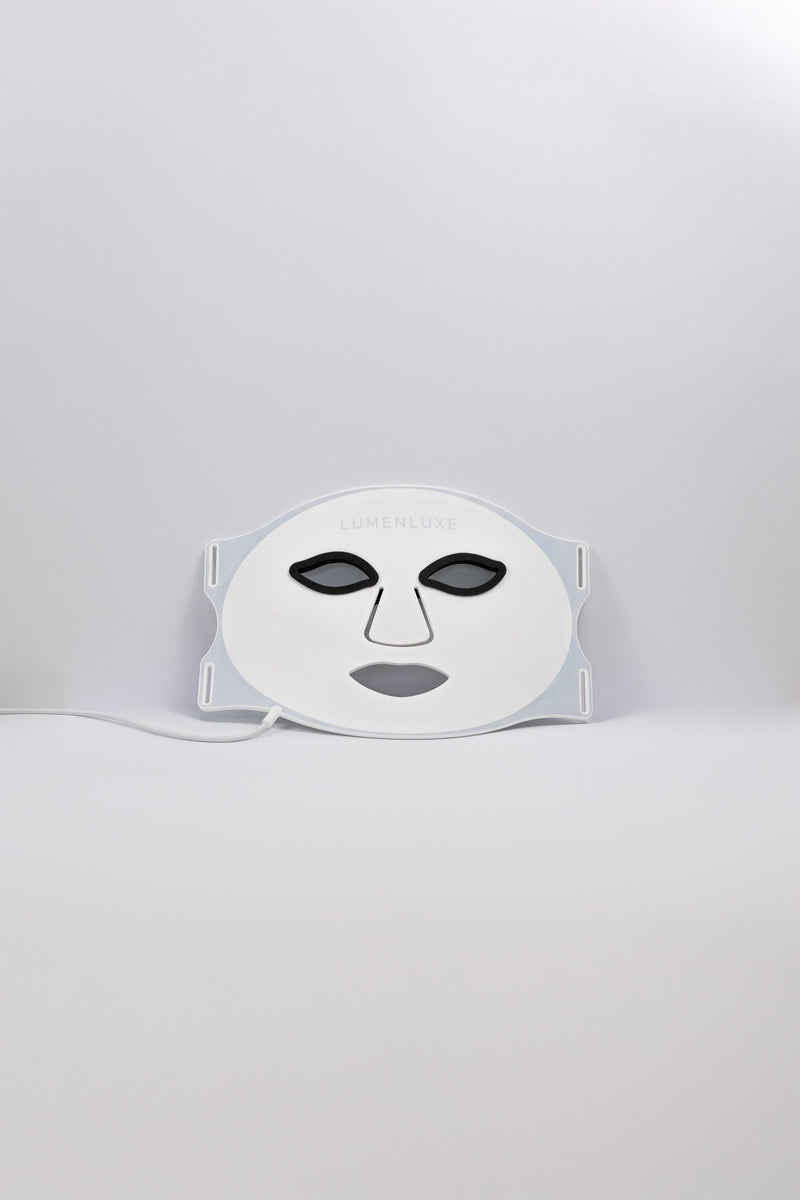
As a rough guide: below 100 LEDs, a mask is more of an add-on than a full treatment. Above 200 LEDs spread over the whole surface, we are talking about coverage that handles the entire face in one cycle. For comparison, the LumenLuxe LED mask has 210 LEDs distributed over the entire inner side, including the edges.

Watch out for one marketing trick: some sellers include in the total count LEDs that only light up in one mode. If the “210 LEDs” figure applies only to the blue mode and forty of them light up in red, the number is true but misleading. Ask how many LEDs light up in each mode.
3. Intensity in mW/cm² — the most important number that almost nobody states
This is the parameter that matters most and is most often missing from product descriptions. It tells you how much energy hits one square centimetre of skin per second. Without it, the number of LEDs is just a number — a hundred weak LEDs deliver less than thirty strong ones.
Common home masks range somewhere between 5 and 25 mW/cm². If the seller does not state the value at all and will not provide it even when asked directly, that in itself is an answer. The LumenLuxe mask works at an intensity of 20 mW/cm², a value at which a ten-minute treatment makes sense. We devoted a separate article to this topic — Not every LED is the same: do you know the output of your mask?
4. Material and shape — rigid shell or silicone
A hard plastic shell is cheaper to produce, but it only rests on the raised parts of the face. An air gap forms between the mask and the skin, which is in a different place and of a different size for every person — and light intensity drops quickly as the distance grows.
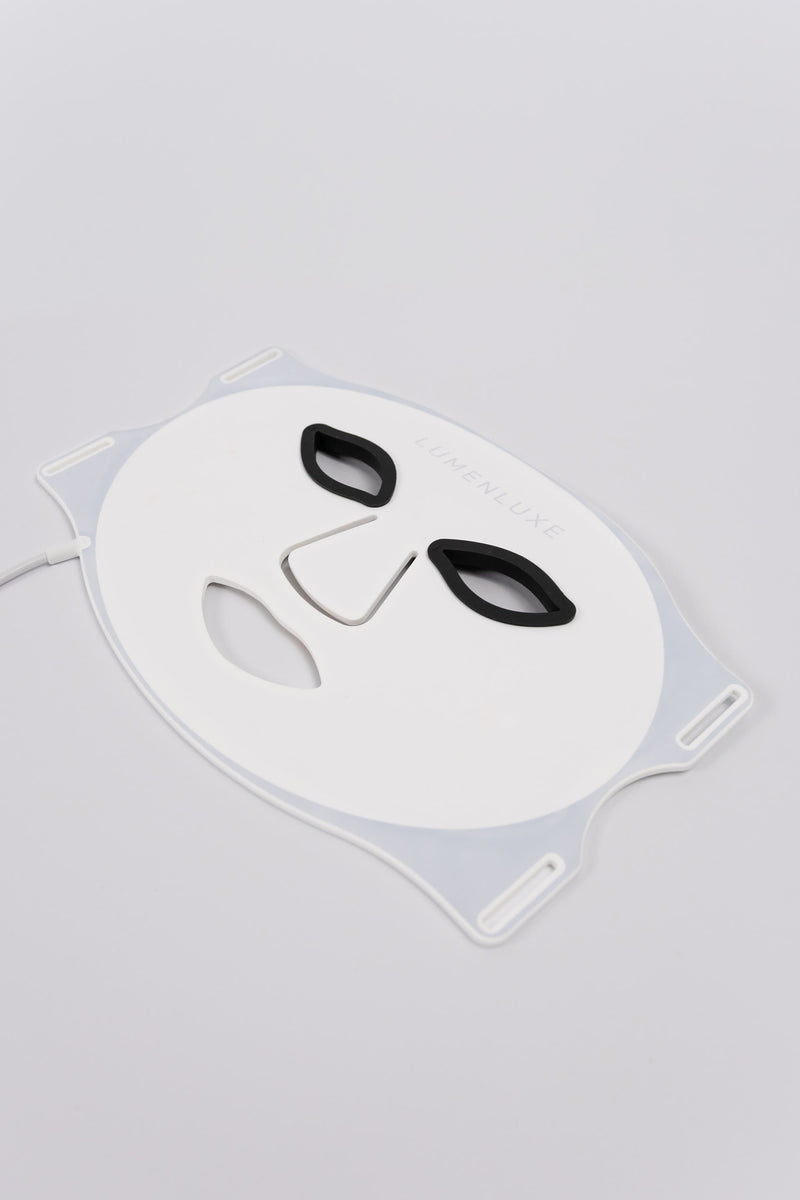
Flexible silicone follows the shape of the face, keeps the LEDs at a constant distance from the skin and can be worn lying down. If you are deciding between two masks with similar parameters, the material is often the difference that decides whether you will really use the mask three times a week or it will end up in a drawer.
The second thing is weight. Above 250 grams, a mask starts to feel uncomfortable after a few minutes. LumenLuxe weighs 145 grams and is made of medical-grade silicone.
5. Power — cable, battery and capacity
A mask powered by a cable from a socket ties you to one spot during the treatment. A mask with its own battery can be used anywhere, but capacity matters: at 1200 mAh it lasts several treatments on one charge, at half that capacity you will be charging it after almost every use.
Look at the connector type too. USB-C means you can charge the mask with the same charger as your phone. A proprietary connector means that if you lose the cable, you have a problem.
6. Certifications — what they mean and what they do not
This is the area with the most misleading claims. In brief:
- CE — a declaration of conformity with European product safety requirements. For a cosmetic device, it is the baseline every product sold in the EU should have.
- RoHS — confirms the restriction of hazardous substances in electronics.
- FDA clearance — a US registration. It does not mean approval or endorsement and has no legal significance in Europe.
- “Clinically tested” — without a reference to a specific study stating the sponsor, the number of participants and the publication, it is just a claim in the description.
A sensible approach: check that the mask has CE and RoHS, and ask for a document for any other labels. A serious seller will send it.
7. Reviews, warranty and returns
Light therapy does not work after a single use. The recommended routine is 10 minutes, 3 to 5 times a week, with the first visible changes after roughly four weeks. This leads to a simple conclusion: a return period shorter than a month will not let you really try the product.
With reviews, look at the number, not the average. A rating of 5.0 from eight reviews says less than 4.8 from a hundred. And look for reviews on an independent platform — Heureka, Google, Trustpilot — not just those on the seller's website. Our customers rate the mask 4.87 out of 5 from 115 reviews; we summarised their experiences in the article LED face mask: reviews and experiences.
Five warning signs
- The description states neither wavelengths in nanometres nor intensity in mW/cm².
- The seller promises a specific result within a specific time (“wrinkles gone in 7 days”).
- The product is described as a treatment for a specific diagnosis. An LED mask is a cosmetic aid, not a medical device.
- There is no traceable seller — address, company ID, contact, real customer support.
- The return period is 14 days or shorter, or it is conditional on unopened packaging.
Who the mask is not suitable for
Light therapy is not recommended in cases of photosensitivity, when taking medication that increases sensitivity to light, with epilepsy, during pregnancy and breastfeeding, and with eye diseases. If you have doubts or are being treated for skin problems, consult a doctor or dermatologist first. We wrote more about safety in the article Safety profile and long-term effects of LED phototherapy.
Pre-purchase checklist
- Wavelengths stated in nanometres
- More than 200 LEDs, distributed over the entire surface
- Intensity stated in mW/cm²
- Flexible silicone, weight up to 200 g
- USB-C and a battery of at least 1000 mAh
- CE and RoHS with an available document
- At least 30 days for returns and a 24-month warranty
- Reviews on an independent platform
Frequently asked questions
Is a more expensive mask automatically better?
No. The price also reflects the brand and marketing. Compare the parameters — number of LEDs, wavelengths and intensity — not the price tag.
Is one light colour enough?
If you are addressing one specific thing, a single-colour mask may be enough. More modes make sense if you want to alternate depending on what your skin needs at the moment.
How long does one treatment take?
With sufficient intensity, usually 10 minutes. If a mask requires 30 minutes or more, it tends to be a sign of lower output.
How long does it take before I see something?
With regular use 3 to 5 times a week, the first changes in the appearance of the skin usually appear after about four weeks. It is not a one-off effect.
Can the mask be used with regular cosmetics?
Yes, the treatment is done on clean, dry skin, and serums and creams are applied only afterwards. You will find the detailed routine in the article How to properly prepare your skin before using the mask.
Summary
A good LED mask is not recognised by its photo, but by what the seller is willing to tell you about it. Wavelengths in nanometres, the number of LEDs in each mode, intensity in mW/cm², material, certifications and a fair return period — these six details tell you more than the whole rest of the description.
If you want to see what these parameters look like together, the LumenLuxe LED mask has 210 LEDs, three wavelengths, an intensity of 20 mW/cm², medical-grade silicone, USB-C, CE and RoHS certification and 60 days for returns.