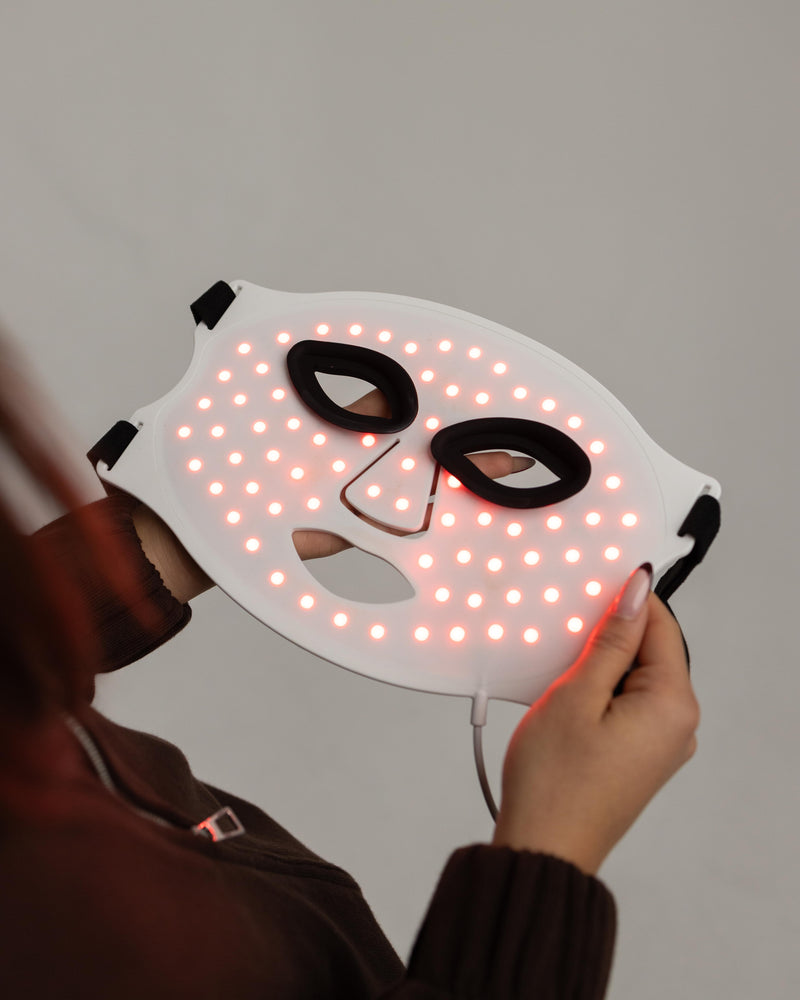
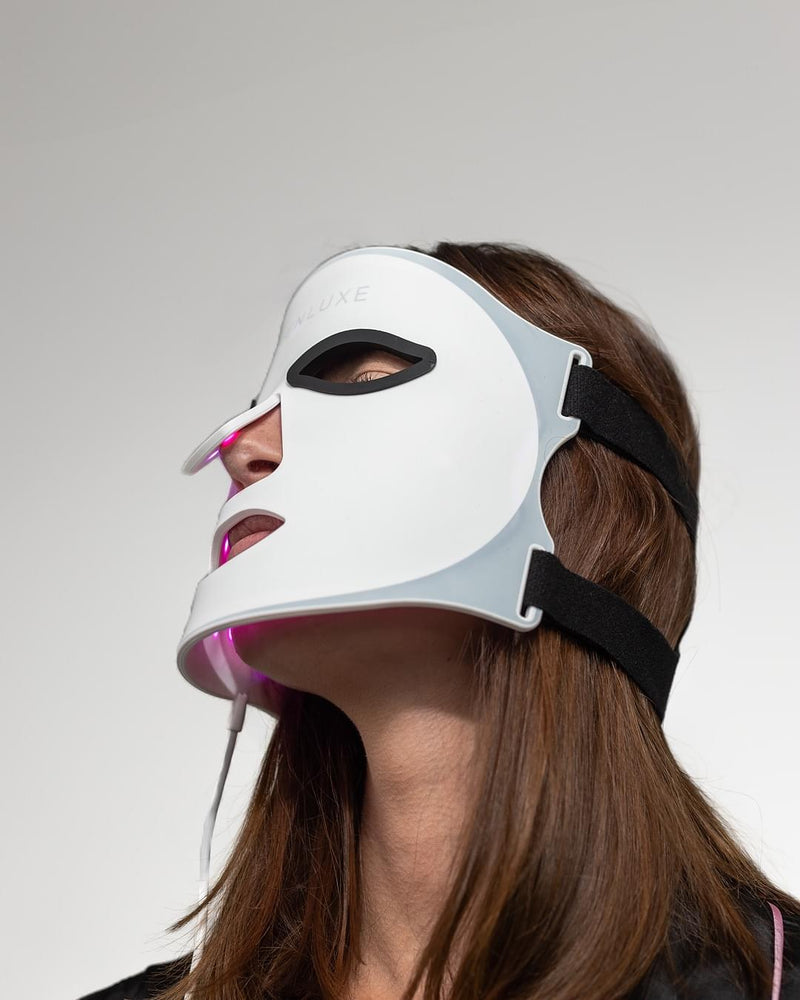
Not Every LED Is the Same – Why LED Facial Mask Power Matters

Did you buy an LED mask and the results never came? Or are you thinking of buying one and don't know how to choose the right one? The problem is not LED therapy — the problem is the power output of the mask you are using.
Not every LED mask is the same. And science proves it.
Why most cheap LED masks don't work
There are hundreds of LED masks on the market. Some cost €20, others €500. The difference is not in the design or the number of colours — it is in the power of the light they produce.
Most cheap masks merely illuminate the skin. The light is visible, the mask glows — but the intensity is not sufficient to penetrate the skin barrier and activate the cells deep down where collagen is formed.
The result? No measurable biological effect. Money thrown away.
The Arndt-Schulz law — the scientific basis of LED therapy
A pharmacological principle formulated back in the 19th century still applies to modern LED therapy today. The Arndt-Schulz law states:
Weak stimuli activate physiological activity. Moderately strong ones support it. Strong ones inhibit it. Very strong ones destroy it.
For LED therapy, this means one key thing — there is a therapeutic window. Below this threshold, cells do not respond at all. Above it, light can cause irritation or inhibition of cellular activity.
A study by Dr. Praveen Arany and colleagues precisely defined this therapeutic window for LED skin therapy.
The therapeutic window — 5 to 50 mW/cm²
The results of Dr. Arany's study are clear. The optimal power for LED skin therapy is 5 to 50 mW/cm². This is the range in which red light penetrates through the epidermis into the dermis, where the fibroblasts reside and where collagen is formed.
Below 5 mW/cm² — the light is too weak. The photons are reflected or absorbed in the surface layer of the skin without any biological effect. The cells do not respond. No collagen, no regeneration.
5 to 50 mW/cm² — the therapeutic window. The light penetrates to a depth of 4 mm, activates the mitochondria and triggers a cascade of biological reactions. This is where visible results happen.
Above 50 mW/cm² — with a fixed treatment duration, the delivered dose goes above the range that the literature describes as stimulating. So more power does not automatically mean a better result.
LumenLuxe delivers a stable output of 20 mW/cm² — right in the centre of the therapeutic window.
Why 20 mW/cm² is the gold standard
Most clinical studies that demonstrated a measurable increase in collagen used a power density in the range of 10 to 30 mW/cm². A value of 20 mW/cm² is optimal for three reasons.
Penetration — at an output of 20 mW/cm², a sufficient number of photons reaches a depth of 4 mm, where the fibroblasts reside. Weaker masks do not reach this depth.
Time efficiency — at 20 mW/cm², a 10 to 15-minute session is enough to reach the target energy dose — the so-called fluence, measured in joules per cm². With a weaker mask at 5 mW/cm², you would have to extend the session to 2 hours to achieve the same biological effect. That is neither practical nor realistic.
Safety — 20 mW/cm² is intense enough to activate cells but does not exceed the threshold at which irritation or inhibition could occur. A cool therapy with no burning or overheating.
TGF-β — molecular proof of why power matters
Dr. Arany's study revealed the precise molecular mechanism of why the right LED light power works and why weak masks don't.
At the right power, LED light activates the growth factor TGF-β — Transforming Growth Factor beta. This molecule acts as the CEO of cellular renewal — it tells the fibroblasts "start producing collagen immediately and repair the damaged tissue."
The key finding: if the power of the LED light is below the therapeutic minimum, TGF-β remains inactive. The cells do not receive the signal to produce collagen. No visible result.
This is the scientific explanation of why cheap, low-power LED masks don't deliver results — it is not a question of the colour of the light or the number of diodes, it is a question of intensity.
How to compare LED masks by power
When comparing LED masks, look for this information in the technical specifications:
Power density or irradiance — stated in mW/cm². Look for a value of 5 to 50 mW/cm².
Energy dose or fluence — stated in J/cm². LumenLuxe reaches 12 J/cm² in a 10-minute session, which is a clinically proven dose for stimulating collagen.
Wavelength — for skin rejuvenation, look for 630 to 660 nm. For acne, 415 to 460 nm.
Certification — CE, RoHS and FC certificates confirm that the device meets European safety standards.

LumenLuxe vs. cheap masks — a comparison
Cheap LED masks costing €20 to €50 typically do not document their power output in mW/cm². That is because their output is below the therapeutic minimum. They glow — but the biological effect is zero or minimal.
LumenLuxe delivers a documented output of 20 mW/cm², a wavelength of 630 nm for red light and 460 nm for blue light, and CE, RoHS and FC certification. It is not a toy — it is a scientifically calibrated device built on the same principles as clinical LED equipment.
The price difference between a cheap mask and LumenLuxe is a few dozen euros. The difference in results is measurable.
Frequently asked questions
How do I find out the power of the mask I already have? Check the technical documentation or the manufacturer's website. Look for a figure in mW/cm². If the manufacturer does not state this figure — the output is most likely below the therapeutic minimum.
Can the power be too high? Yes — above 50 mW/cm², light can cause inhibition of cellular activity or irritation. LumenLuxe, at 20 mW/cm², is safely within the therapeutic window.
Does the Arndt-Schulz law also apply to blue light? Yes — the same principle applies to all LED therapy wavelengths. The optimal therapeutic window for blue light in acne treatment is similar to that for red light.
Why does LumenLuxe have 210 LED diodes and not more? The number of diodes is not decisive — what matters is the power of each diode and the total power density per cm². LumenLuxe is optimised for an output of 20 mW/cm², not for the maximum number of diodes.
How long does a session take at 20 mW/cm²? 10 minutes is enough to reach the clinically effective energy dose of 12 J/cm². A longer session does not bring proportionally better results.